Automatic Rally
The bullish movement that appears as the first signal of buying interest, marking the Change of Character toward lateralization.

Rubén Villahermosa
Trader and educator
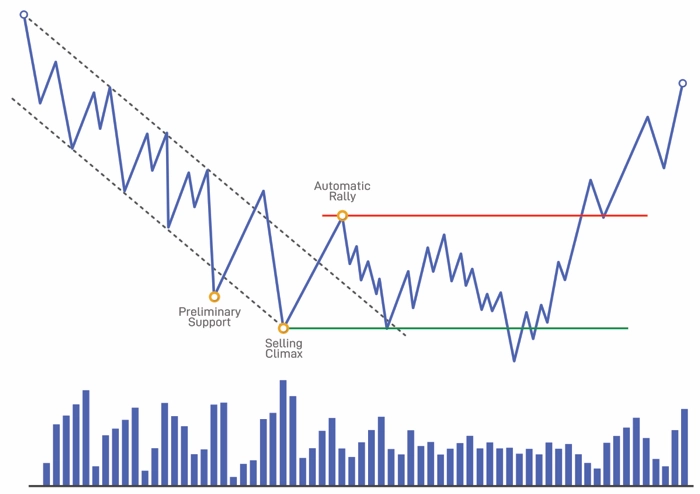
The Automatic Rally marks the first significant bullish movement after the Selling Climax
Article Summary
The Automatic Rally (AR) is the bullish movement that develops after the Selling Climax, appearing as the first signal of buying interest. It represents the most significant rally since the bearish trend began, signaling the Change of Character (ChoCh) toward lateralization. It establishes the upper limit of the accumulation structure. It occurs due to supply exhaustion + short covering + new demand. The distance traveled indicates the strength of underlying demand.
The Automatic Rally is a bullish price movement that develops after the end of the Selling Climax and appears as the first signal of buying interest.
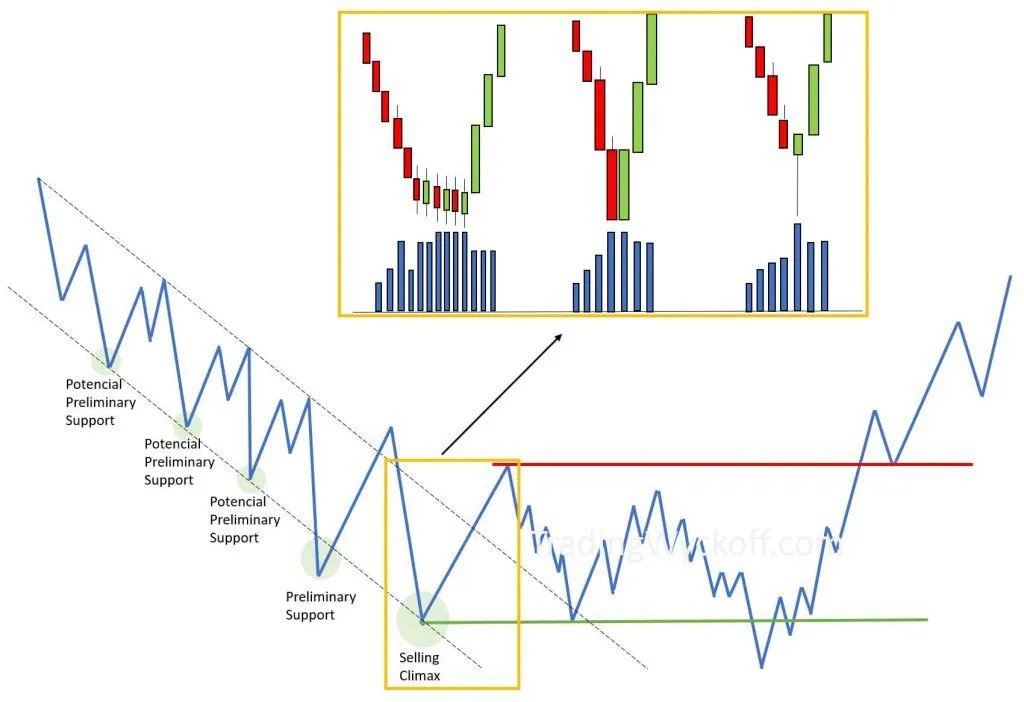
It is an event that forms part of Phase A of stopping the previous trend and takes place after the Preliminary Support and the Selling Climax.
Change of Character (ChoCh)
This bullish movement will be the most important since the market started its bearish trend phase. It suggests an entry of demand and signals a change of character.
This ChoCh (Change of Character) has great implications as it signals a change in market context; the ChoCh appears to end the bearish trend and initiate a price lateralization environment.
This behavior change must be confirmed with the last Phase A event: the Secondary Test. With its appearance, we can confirm the new environment in which the market will move from that moment on.
Why the Automatic Rally Occurs
During the bearish trend, price will have moved down a considerable distance and possibly reached an oversold condition in the development of the Selling Climax where the following actions take place:
- Supply exhaustion. Aggressive sellers stop entering the market.
- Short covering. Sellers who entered higher up close their positions.
- Demand appearance. New buyers enter upon observing the climactic event.
The market has reached levels that are not interesting to continue selling, which will cause an absence of supply.
The withdrawal of sellers, both those who stop selling aggressively and those who take profits from their shorts; along with the appearance of new buyers (possibly with mean reversion strategies), will cause an easy upward push of prices.
Video in Spanish with English subtitles available

Uses of the Automatic Rally
Delimit the Upper Limit
Within the accumulative structures of the Wyckoff methodology, it is one of the important elements since its high establishes the upper limit of the range, delimiting a clear resistance zone where new selling is expected on subsequent visits.
Confirm the Selling Climax
The Automatic Rally is of relevant importance since sometimes it won't be very clear when the genuine Selling Climax has appeared. Therefore, we often recognize the climactic action after identifying the change of character that comes with the Automatic Rally.
Identify Market Context
After identifying the Selling Climax and the Automatic Rally, we identify the market's change of character (ChoCh) and we know that price will go down to test that climactic action to develop the Secondary Test. We now have a market map.
This is very important because if you've correctly identified the Selling Climax and now the Automatic Rally, you can drop to a lower timeframe to look for the development of a minor distribution structure that generates the end of the Automatic Rally and the bearish turn that will seek the development of the Secondary Test.
Take Profits from Long Positions
If you boldly bought at the Selling Climax looking for that bullish bounce, this position should not be held throughout the range development, since we cannot initially know if it will be an accumulation structure to go up or if it will be a redistribution to continue falling.
The most sensible thing would be to close the position on the Automatic Rally obtaining the profit from a scalp.
Implications of Its Development
The distance this bullish movement travels will be one of the elements we take into account later as the structure develops in order to try to determine what the large professional is doing.
We must keep in mind that a short-distance Automatic Rally does not have the same implications as one that is significantly (in comparative terms) larger.
For example, in a market where the last bullish movements have developed with an average of 50 points; and suddenly an Automatic Rally of 100 points is observed, it suggests greater underlying strength.
When we see an Automatic Rally but the movement is intertwined, doesn't travel a great distance and has decreasing volume, it indicates that demand is of poor quality and suggests the market is still under seller control.
Most likely the subsequent Secondary Test will develop relatively soon and may surpass the lower limit established by the Selling Climax low, indicating great underlying weakness.
Warning: If we start from this type of behavior, we must question whether what is taking place in the market is an accumulation for a subsequent price rise. With this apparent weakness, the most sensible thing is to think of a redistribution process that originates lower prices.
Anatomy of the Automatic Rally
Generally, volume at the start of the movement will be large, we are at the end of the Selling Climax and normally this price turn occurs with climactic volume (except for the appearance of Selling Exhaustion).
As the Automatic Rally progresses, volume will decrease until at the end it is relatively low. This volume drying up suggests lack of interest in continuing to rise and will end the Automatic Rally.
With price ranges practically the same thing happens. At the beginning of the movement we will observe wide ranges, good trend candles/bars that will progressively narrow as they approach the end of said event.
AR Development Stages
Start: High volume and wide ranges
Climactic beginning with significant participation (short covering + new demand). Good trend candles.
Development: Progressive decrease
Volume decreases as the movement matures. Ranges narrow.
End: Low volume and narrow ranges
Signals that bullish interest is exhausting. Bars become smaller.
Through continuous practice you will develop the necessary judgment to know when the narrowing of ranges and the decrease in volume have reached a point where the movement is likely to stop. There are no fixed or mechanical rules, it's rather a matter of judgment.

Wyckoff Methodology in Depth
This article is an excerpt from the book. If you want to master all Phase A events and fully understand the change of character, the book provides all the necessary knowledge.
View book