Distribution
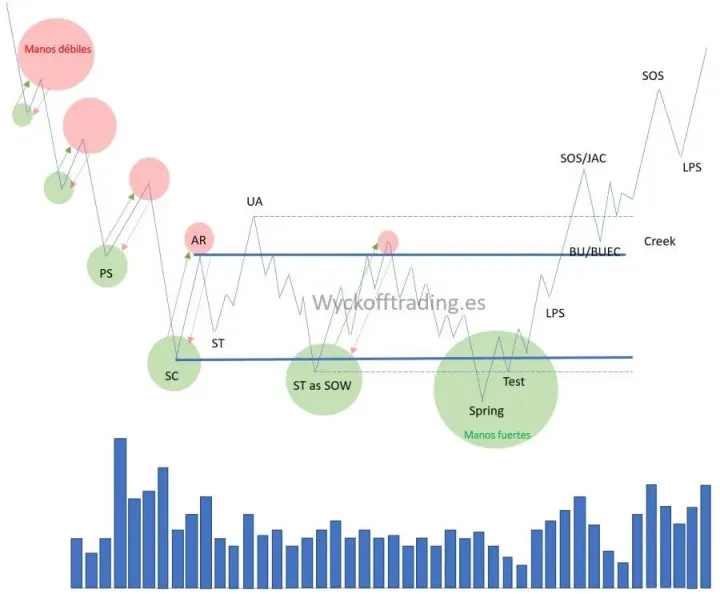
A distribution range is a lateral price movement that manages to stop an upward movement and in which a stock selling process occurs by well-informed professionals who have interests at lower prices. They try to build a large position to dispose of it at lower prices and obtain profitability from it.
Key Concept
Distribution is the opposite process to accumulation: while in accumulation professionals buy, in distribution they sell their stock to poorly informed traders.
The Law of Cause and Effect
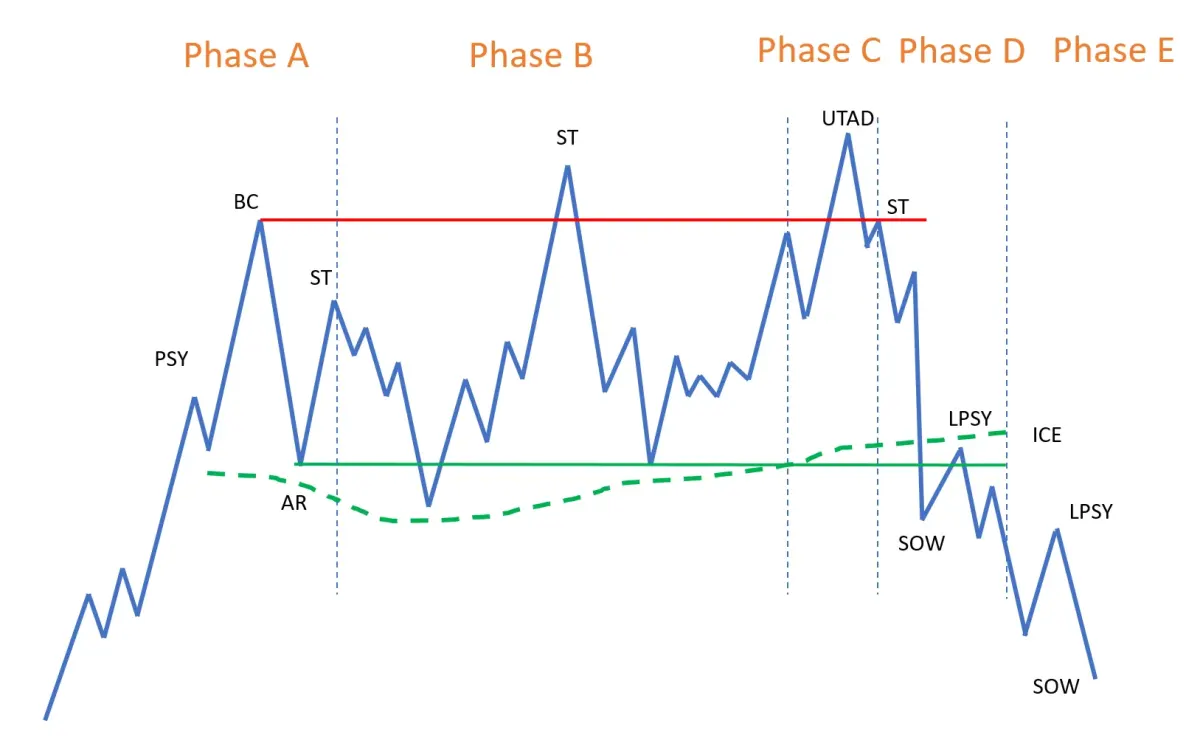
It is in these range conditions where we see the law of cause and effect in action, so well known in the trading world; which tells us that for there to be an effect, there must first be a cause that originates it; and that the effect will be in direct proportion to the cause.
In the case of the distribution range, the stock selling (cause) will have as its effect a subsequent bearish trend movement; and the reach of this movement will be in direct proportion to the time the price has spent building that cause (absorbing stock).
Preparing an important movement takes considerable time. A large operator cannot build their entire position at once because if they executed their sell orders with an order containing all the quantity they want, the aggressiveness of the order itself would push the price down until finding the necessary demand to match their sell orders, resulting in worse prices.
To execute this task, professionals need to develop and carry out a careful plan to try to absorb all available demand in the market at the highest average price possible.
Manipulation Maneuvers
During this distribution process, large operators, supported by the media (often at their service), generate an environment of extreme strength. What they seek with this is to attract as many traders as possible since it will be the purchases of these traders that provide the necessary counterparty to match their sell orders.
Market Trap
Poorly informed traders don't know that strong professionals are building a large selling position because they have interests lower down. They will be entering on the wrong side of the market. Through various maneuvers, they gradually manage to acquire all available demand.
In the distribution range, just like in accumulation, we will be presented with the fundamental shakeout event. While it's true that not all structures will show this action before starting the trend movement, its presence adds great strength to the scenario.
The Upthrust
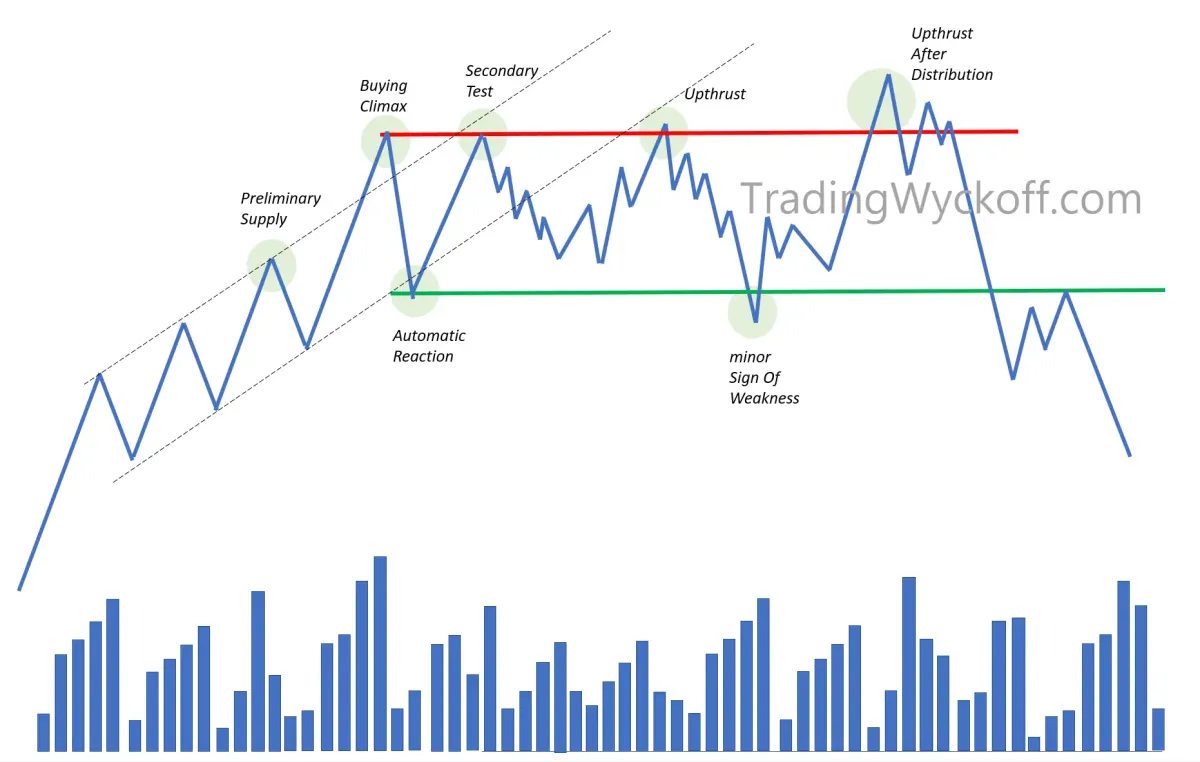
For the bullish shakeout case, the Wyckoff methodology calls it "Upthrust". It's a sharp upward movement that breaks the resistance level of the range and which large operators use to carry out a triple function:
At the same time, they need to remove "weak hands" from the market. These are traders who, if positioned short, will close their positions very soon taking small profits; and that closing of sell positions are buy orders that large operators will have to continue absorbing if they want to keep pushing the price.
An action they carry out to get rid of this type of weak trader is to generate a flat, boring market context, with the goal of discouraging these traders so they eventually close their positions.
Counterparty, Liquidity
Professionals building their position are obligated to carry out this type of maneuvers. Due to the magnitude of their positions, it's the only way they can operate in the markets. They need liquidity to match their orders and the shakeout event is a great opportunity to get it.
Liquidity Mechanics
The triggering of stops from sell positions, as well as traders going long, are buy orders that necessarily must cross with a sell order. And indeed, it's the well-informed operators who are placing those sell orders and therefore absorbing all the purchases being executed.
Additionally, when the bearish reversal occurs after the shakeout, the stops of those who bought will also be executed, adding strength to the bearish movement.
The Path of Least Resistance
Once the development of the range is coming to an end, large professionals will not initiate the bearish trend movement until they can verify that indeed the path of least resistance is to the downside.
They do this through tests with which they evaluate buying interest. They initiate upward movements and depending on the participation that follows (this will be observed through the volume traded in that movement) they will assess whether there is available demand or if on the contrary buyers are exhausted. An absence of volume at this point would suggest a lack of interest in reaching higher prices.
"This is why sometimes more than one shakeout is seen within the range; these are tests that professionals develop to make sure they will not encounter resistance at lower prices."
— Wyckoff MethodologyCommon Characteristics of Distribution Ranges
The following are key characteristics of distribution ranges:
High Volume and Volatility
During the development of the range. Wide price fluctuations will be observed and volume will remain relatively high and constant.
Tests to the Lower Zone Without Volume
Suggesting an absence of buying interest; except when the price is ready to initiate movement outside the range.
Bullish Shakeouts (Upthrust)
To previous highs; either above the resistance area or above minor highs within the range.
Wider and More Fluid Bearish Movements and Bars
This denotes quality supply entry and suggests that demand is of poor quality.
Development of Lower Highs and Lower Lows
This sequence should already be observed in the last stage of the range, just before initiating the bearish jump. What it suggests is that bears are being more aggressive.
Start of the Bearish Movement
When there is no more available demand, an inflection point takes place. Strong hands have control of the asset and they will only dispose of their positions at much lower prices. A slight increase in supply now would cause a sharp downward movement in prices initiating the bearish trend.
Redistribution
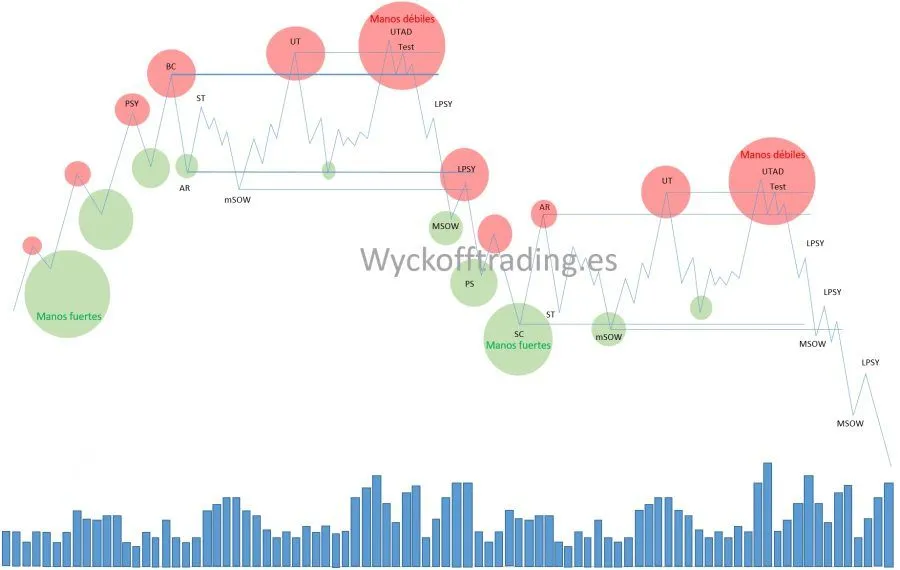
The redistribution phase is a range coming from a downtrend and followed by a new downtrend. Within a large bear market, multiple redistribution phases can occur. It's a pause that refreshes the asset to develop another downward movement.
Redistribution or Accumulation
This type of structure begins the same as accumulation ranges; so a very judicious analysis is necessary to avoid reaching erroneous conclusions.
Analysis Difficulty
This aspect is undoubtedly one of the most difficult tasks for the Wyckoff trader: knowing how to distinguish between a redistribution range and an accumulation range.
Stock Control
During redistribution periods, the large professional who is already positioned short sells again around the top of the range and potentially covers (closes/buys) some of their positions near the base of the range.
In general, they are increasing the size of their short position during the development of the range. The reason they close some of their sell positions at the base of the range is to provide price support and not push it prematurely downward before being able to establish a significant short position.
Redistribution remains volatile during and at the end of its development before continuing the downtrend.
Change of Control
The hands that control the asset will change during the course of the trend. At the beginning of a downtrend, the asset is under the control of very strong owners (Professional operators, strong hands); but as it develops, the stock will gradually change toward less informed traders, weak hands. At this point, supply is said to be of poor quality and the market needs to start a new stock absorption process in which large operators once again take control.
Structure Duration
The percentage of strong hands and weak hands that have control of the asset will influence the duration of the structure. If at the beginning of the redistribution the asset is still mainly in strong hands, the duration of the structure will be shorter. If on the contrary it is the weak hands that control most of the stock, a longer period of time will be necessary in which to develop the selling process again.
The main distribution objectives will not yet be fulfilled and this structure develops to add new selling positions to the market with which to continue the downward movement toward those objectives.
The Wyckoff Methodology in Depth
The best-selling book on the Wyckoff Method. Learn to identify accumulation and distribution structures and all the events of the method with practical examples.