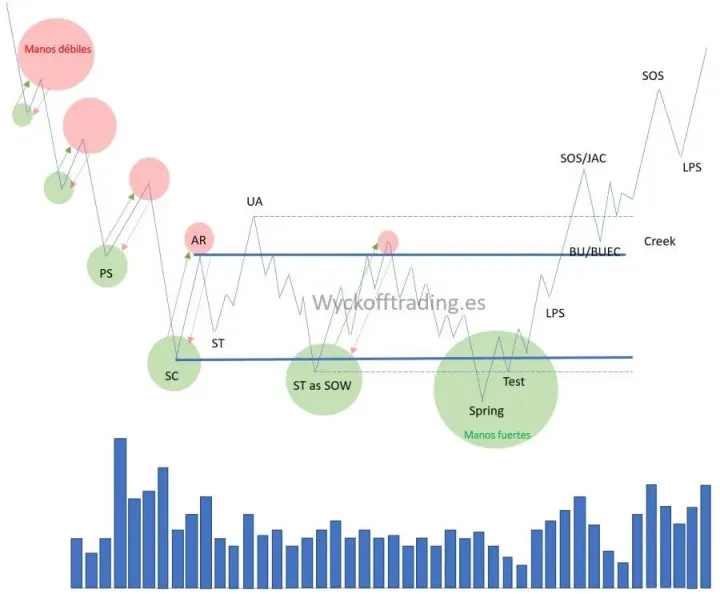
The law of effort vs result is fundamental to understanding the relationship between volume and price. This analysis allows you to detect professional money participation and anticipate directional changes.
The Importance of Volume
Price is not the only important factor in financial markets. A perhaps even more important factor is the character of volume.
Volume identifies the quantity of shares, units or contracts that change hands in a given period.
Key Concept
Professional operator participation is identified by observing an increase in volume. When professional operators become interested in an asset, this is reflected through significant volume increases.
Volume is the only window we have into institutional operator activity. Without volume, we don't know if there is professional interest or not.
The Law of Effort vs Result
"Every action requires an equivalent and opposite reaction. Volume represents effort while price represents result. Without effort there can be no result."
- Wyckoff Methodology
This law allows us to evaluate who dominates the market (buyers or sellers) through convergence and divergence analysis between price and volume.
Effort
Represented by volume. High volume indicates that much effort is being put into the movement.
Result
Represented by price movement. The result must be proportional to the effort applied.
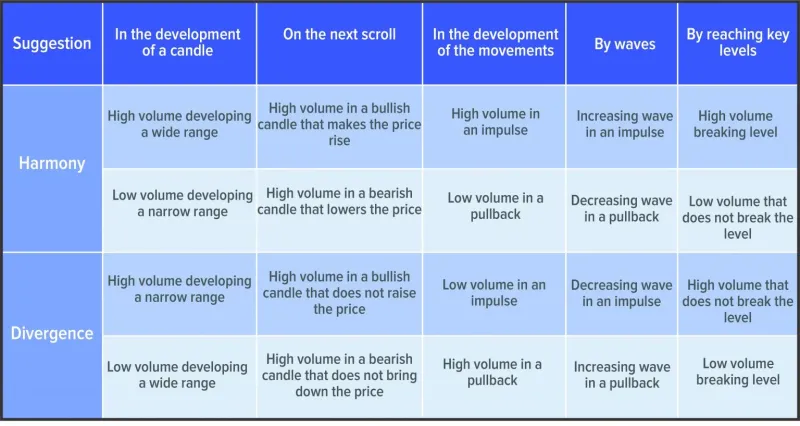
Harmony
Harmony: When effort (volume) converges with result (price), there is harmony. This indicates strength and suggests continuation of the current movement.
Videos in Spanish with English subtitles available


Harmony Scenarios
Signs of Harmony
- High volume + wide movement: Great effort produces great result. Genuine movement.
- Low volume + small movement: Little effort produces little result. Normal consolidation.
- In both cases, effort and result are proportional.
Interpretation
Harmony confirms that the movement is genuine. If you see a bullish impulse with high volume that produces a significant advance, the movement has real strength behind it.
Proportional Relationship
Price movement provides a direct relationship with the amount of effort applied:
- Greater effort → Movements of greater duration and amplitude
- Less effort → Shorter and more limited movements
Divergence
Divergence: When effort (volume) does not produce the expected result, there is divergence. This signals weakness and possible reversal of the movement.
Divergence Scenarios
Warning Signs
- High volume + little movement: Great effort without result. Someone is absorbing the movement.
- Low volume + wide movement: Little effort with great result. Movement not sustainable.
- In both cases, there is imbalance between effort and result.
Alert Signal
Divergence is an important alert signal. If you see an attempt to rise with very high volume but the price barely advances, it means there are sellers absorbing all the buying. The bullish trend is in danger.
Magnitude of Divergence
In divergence, the result provides direct relationship with the magnitude of divergence:
- Minor divergences → Minor results/reversals
- Major divergences → Major results/reversals
Analysis Table
To correctly analyze the effort/result relationship, observe each bar or set of bars:
| Volume | Movement | Interpretation |
|---|---|---|
| High | Wide | Harmony - Continuation |
| High | Scarce | Divergence - Absorption |
| Low | Scarce | Harmony - Normal pause |
| Low | Wide | Divergence - Weak movement |
Practical Application
A significant increase in volume indicates the presence of professional money destined to produce continuation or reversal movements:
Observe Volume
Identify when there is significant professional participation through volume spikes.
Evaluate the Result
Is the price movement proportional to the volume? Is there harmony or divergence?
Draw Conclusions
Harmony suggests continuation; divergence suggests imminent change of direction.
Remember: Effort and result analysis does not predict direction by itself, but it tells you the quality of the current movement. A movement with harmony is reliable; one with divergence is suspicious.
Wyckoff in Depth
This article is an excerpt from the book. If you want to master volume and price analysis according to the Wyckoff methodology, the book provides you with all the necessary knowledge with practical examples.
View book