Forex Volume: Why It's Not Reliable
Forex is decentralized — your platform shows broker volume, not market volume. Two ways to fix this for serious analysis

Ruben Villahermosa
Trader and Educator
Volume is one of the most powerful tools in technical analysis — when it's reliable.
The volume you see on your Forex platform doesn't represent the total volume traded in the currency market — only your broker's. Forex is a decentralized market where each broker operates as its own isolated market, unlike futures, which are centralized and have consolidated real volume. For serious FX analysis there are two options: use the volume of the largest brokers (OANDA is widely used) or leverage futures/CFD arbitrage by analyzing $6E to trade $EURUSD.
If you look at volume on your Forex platform and believe it's "the volume of the market", I have bad news: it isn't. This is probably the most widespread misunderstanding among currency traders who try to apply volume-based techniques — from volume profile to Wyckoff analysis or order flow reading.
The problem: Forex is decentralized
Let's start with the root of the matter. Forex is a decentralized market. And this technically means that each broker has its own market.
There's no single physical or virtual venue where all the world's currency transactions take place. There's also no central authority consolidating transactions executed across thousands of brokers, banks and liquidity providers. Each operates its own network — its own counterparties, its own feeds, its own internal order book.
The direct consequence: each broker trades its own volume. There's no way to analyze the total currency market volume — because that "total" isn't measured anywhere.
Centralized vs decentralized: why it matters
To grasp why Forex is a special case, compare it to markets that do offer real aggregated volume. The difference is structural, not commercial:
Centralized market (futures)
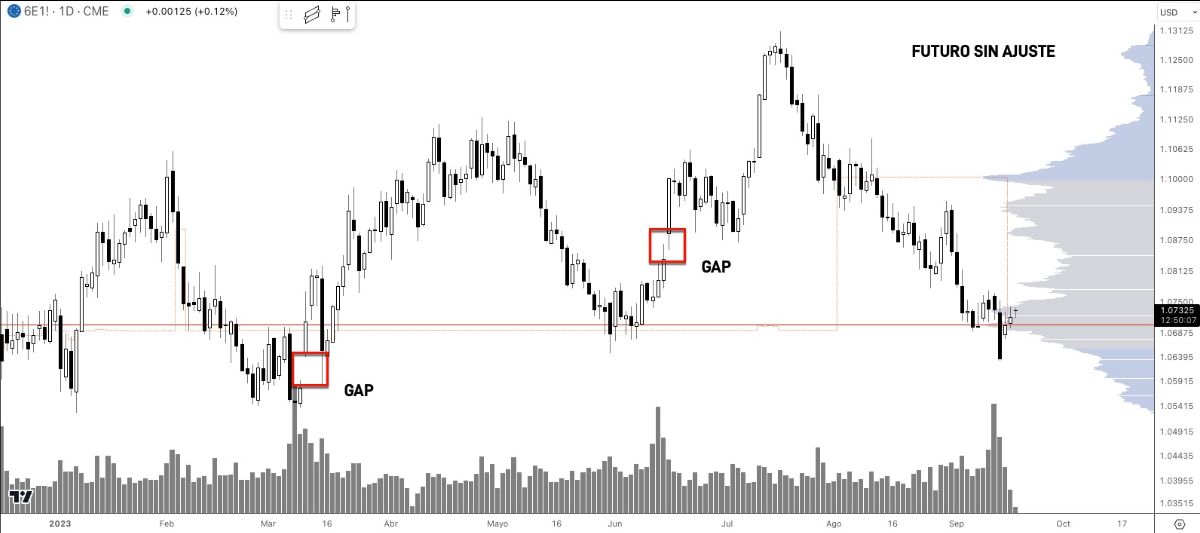
All participants must trade on a single market. Euro dollar futures (ticker $6E) trade on CME. If you buy and someone else sells, that transaction is recorded in the same common order book. The reported volume is the real total market volume.
Decentralized market (Forex)
Each broker is its own market. If you trade $EURUSD on OANDA and another trader takes the same trade on IG, those are two transactions on different books. Neither OANDA nor IG sees the other's volume. Each reports only its internal volume.
This structural difference has huge operational consequences: futures volume can be used for profile analysis, value areas, price-volume divergences, and institutional reading. Forex volume cannot — at least not without understanding the limitation.
What you really see when looking at Forex volume
When your Forex platform shows you a volume column at the bottom of the chart, what you're seeing is volume traded inside your broker. Not the global volume of the pair. Not institutional volume. Just the portion that flows through that specific broker's counterparties. And, to make matters worse, that "volume" in Forex is almost always tick volume — not real volume: it counts price changes, not contracts actually traded.
The mental rule that helps: Forex volume is a sample, not the total. The bigger the broker, the more representative the sample of real market behavior. The smaller the broker, the more biased it is relative to global institutional volume.
And this isn't the only platform-level detail that distorts what you see. If you're using order-flow indicators, also check why TradingView's Volume Delta isn't a real Delta — same family of issues, different angle.
Two options for the Forex trader
If you trade Forex and want to use volume as an analysis input, you have two reasonable paths:
Use volume from the largest brokers
If your trading is exclusively Forex, the most sensible move is to analyze the volume of a large broker, since they move the most volume and offer a closer sample to aggregate market behavior. OANDA is one of the most used as a Forex volume reference. Other large institutional brokers (Saxo Bank, Dukascopy, IG, Interactive Brokers) also offer reasonable samples. The idea is always the same: maximize representativeness by picking the broadest feed you have access to. It won't give you the real total, but it'll give you the best approximation you'll get.
Futures / CFD arbitrage: analyze one, trade the other
The cleanest intermediate solution for serious analysis. You analyze the volume of the corresponding futures contract (centralized market, real volume) and trade the CFD (Forex, better spreads and leverage for many retail traders). Concrete example: analyze ticker $6E (euro dollar future on CME) for your technical reading with volume, then execute trades on the $EURUSD CFD at your usual Forex broker. It works because both markets move identically thanks to the arbitrage mechanism we'll see next. If you go this route, also keep in mind the quarterly rollover of contracts: I cover that in the article on the B-ADJ button and futures rollover.
Why futures-CFD arbitrage works
The reason you can analyze $6E and trade $EURUSD without losing technical fidelity is the arbitrage mechanism. Both instruments represent exactly the same underlying — the EUR/USD exchange rate — but they trade on different markets. And participants with arbitrage capacity don't let their prices drift significantly.
If at any moment the $6E future quotes high enough above the $EURUSD CFD to cover fees, arbitrageurs immediately sell the expensive one and buy the cheap one, closing the difference in seconds. This operation, repeated thousands of times per day by institutional algorithms, keeps both prices essentially aligned in real time.
The practical takeaway: the levels you detect on $6E (where you do see the real volume of the futures market) are the same levels trading the $EURUSD you quote at your Forex broker. A few pips differ due to hours, fees or broker liquidity, but the price structure is identical.
This lets you have the best of both worlds: technical analysis on real volume (centralized futures) and execution on the instrument that fits you best (CFD with retail conditions). It's exactly what many professional traders do without telling you.
Same principle works for:
- ✓Euro dollar: analyze $6E, trade $EURUSD
- ✓British pound: analyze $6B, trade $GBPUSD
- ✓Yen: analyze $6J, trade $USDJPY (watch out for the inverse ticker convention)
- ✓Swiss franc: analyze $6S, trade $USDCHF
- ✓Australian dollar: analyze $6A, trade $AUDUSD
- ✓Gold: analyze $GC future, trade $XAUUSD CFD
Combine this with proper technical reading — volume profile on the future, value areas, intraday operations on institutional levels — and you have one of the most solid methodologies for currencies and commodities.

Analyzing volume and order flow with real tick data —a headache in Forex— is something I do in NinjaTrader.
Affiliate link · paid partnership with NinjaTrader · #ad #NinjaTraderPartner
Summary: how to handle volume in Forex
Key takeaways
- • Forex is decentralized: each broker has its own market and its own volume
- • The volume you see on your platform is a broker sample, not the total pair volume
- • Futures are centralized: the volume of the euro dollar future ($6E on CME) is the real aggregated market volume
- • If you only trade Forex: use volume from a large broker (OANDA or another institutional) as the best approximation
- • For serious analysis: analyze futures, trade CFD. Arbitrage keeps both prices aligned
- • Works for currencies and commodities (gold, oil, etc.) — the principle is the same
When we talk about using volume well — knowing where value areas are, points of control, institutional levels, price-volume divergences — it's no longer just about picking the right broker. It's about knowing how to read what the volume is showing. That reading, applied step by step to volume profile and market profile, is what I cover in the Advanced Wyckoff Course.
Advanced Wyckoff Course
Read volume the right way — on the right data
Master the complete Wyckoff Method + Volume Profile and learn how to extract real institutional information from the markets — including Forex done right.
View the Advanced Wyckoff Course