Order Flow
Do you really know how order flow works? Discover the truth about this popular tool and why it's not the Holy Grail of trading.

Rubén Villahermosa
Trader and educator
Article Summary
Order Flow is an advanced trading technique that analyzes order matching in real-time to understand the interaction between supply and demand. It includes tools such as the order book, Time & Sales, Delta, and Footprint. It is useful for confirming signals but is not the Holy Grail of trading: it needs to be complemented with other methodologies like Wyckoff.
In this article we will dive deep into one of the most popular tools in recent years within the trading world: Order Flow or order flow analysis.
With this tool, the goal is to analyze order matching in real-time to obtain a picture of the interaction between supply and demand.
Important Warning
It's a very good tool but don't be fooled: Order Flow trading is not the Holy Grail. After reading this article you will understand it perfectly.
Video in Spanish with English subtitles available

Auction Theory
The financial assets market is an auction process in which buyers and sellers are linked with the objective of reaching an agreement.
These agreements that operators reach cause price movements.
We must differentiate two types of operators according to their action: active operators (aggressive market orders) and passive operators (limit orders that add liquidity).
Active operators are those who show their intention to trade through aggressive "market" orders. These operators take the price shown on the BID or ASK at that moment with the objective of ensuring their entry; that eagerness to participate gives them a very important characteristic: they are the true drivers of price movement.

Passive operators are responsible for adding liquidity by placing limit orders on the BID and ASK. These orders remain pending execution until the price reaches their level.
Key Concept
The price changes as transactions are matched between buyers and sellers. It is the aggressive order that initiates the negotiation and moves the price, always matching with an opposite limit order.
Price rises looking for sellers and falls looking for buyers. Therefore, as price rises, demand decreases and supply increases; and as price falls, supply decreases and demand increases.
When the market is in equilibrium, buyers and sellers are comfortable trading in a price zone (visualized as a range). When there is an imbalance, price leaves that zone and initiates a trending movement. These concepts are fundamental in auction market theory.
Order Types
You need to fully understand the spectrum of orders we encounter when trading:
Buy Market / Sell Market
Aggressive order executed immediately at the current price. For buying or closing positions.
Buy Stop / Sell Stop
Pending order that activates when price reaches a level. It becomes a market order.
Buy Limit / Sell Limit
Pending order placed at a specific price, waiting for execution. Adds liquidity to the market.
Buy Stop Limit / Sell Stop Limit
Combination of the above. Activates as a limit order after reaching a trigger level.

Order Matching
Fundamental Mechanism
The final result will always be a match of Buy Market with Sell Limit (reflected in the ASK), or Sell Market with Buy Limit (reflected in the BID).
Order Matching Rules
- Buy Market matches with Sell Limit, reflected in the ASK
- Buy Stop becomes Buy Market, reflected in the ASK
- Buy Limit matches with Sell Market, reflected in the BID
- Sell Market matches with Buy Limit, reflected in the BID
- Sell Stop becomes Sell Market, reflected in the BID
- Sell Limit matches with Buy Market, reflected in the ASK
Trading Tools
Thanks to certain Order Flow analysis tools, we can see all the interaction between buyers and sellers participating in the market.
Order Book (DOM)
Through the order book we can observe all pending orders located in the BID and ASK columns. The BID represents buy orders waiting and the ASK represents sell orders waiting.
Time & Sales (Tape Reading)
Through the tape we can see all order matching in real-time. The analysis becomes very complex due to the speed of today's markets.
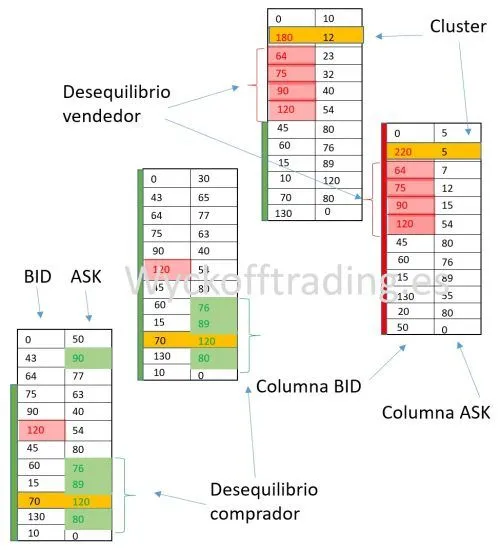
Delta
Delta measures the difference in volume traded on the BID and ASK over a given period of time.
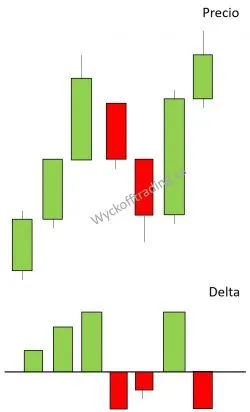
Common Mistake
There's a very common error in thinking that all volume traded on the ASK is buying and all on the BID is selling. Then why do we see bearish movements with positive deltas? If it were that simple, we would have found the Holy Grail.
Video in Spanish with English subtitles available

The Order Flow Problem
The Fundamental Problem
Order Flow programs are configured to always reflect aggressiveness, without being able to distinguish the intention behind the executed orders. This is the most important limitation.
When we see an order executed on the BID, it will always be a match of Sell Market with Buy Limit. But the program cannot identify if that market sell is:
- A short entry to add selling pressure
- A Sell Market to manually close a long position
- The execution of a Stop Loss from a long position
- Profit taking from a short position
- A long entry through limit buy orders
Practical Example
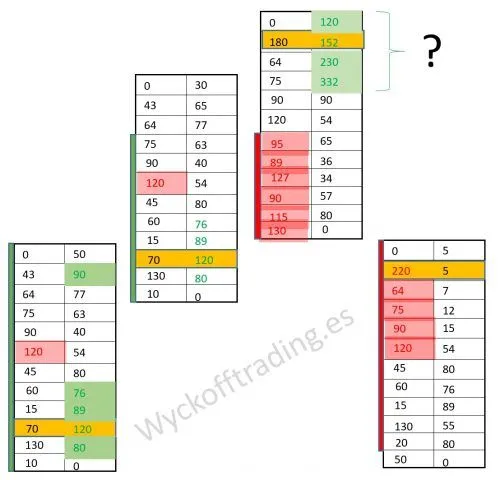
If we see a bullish development with large orders executed on the ASK, followed by a turn to the downside, this offers us multiple interpretations:
Some will say they are trapped buyers. Others that they are Stop Loss executions from sellers. Others that they are profit taking from longs. And others that it's a passive entry of sellers (absorption). Most likely it's a bit of everything.
"The truth is that we cannot determine exactly what the true origin of those executions is. Trying to determine it remains on a totally interpretable, subjective and not very solid plane."
- Rubén Villahermosa

Real order flow (footprint, delta, the tape) needs tick-by-tick data. The platform I use to analyze it is NinjaTrader.
Affiliate link · paid partnership with NinjaTrader · #ad #NinjaTraderPartner
Conclusion
The conclusion I personally draw about Order Flow analysis is that I don't find its operation to be a determining advantage.
My Recommendation
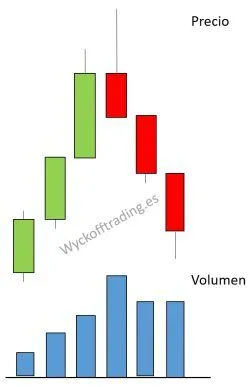
Our task as traders is to identify when imbalances between supply and demand occur and trade in their favor. The interpretation of price action and volume, the basis of the Wyckoff Method, offers us a much more objective approach than Order Flow.
What matters is the final action. This is what gives us context. And context, I firmly believe, gives us an edge. If you want to go deeper into how to combine Order Flow with other tools, I recommend the article on Volume Profile.
Video in Spanish with English subtitles available

Wyckoff 2.0: Structures, Volume Profile and Order Flow
In this book I develop these concepts in much more detail, including supporting charts and practical examples. You will learn to combine price and volume analysis with the most advanced tools.
View book