Preliminary Support
The first attempt to stop a bearish movement: an early warning that the trend may be ending and the accumulation process is beginning.

Ruben Villahermosa
Trader and educator
Article Summary
The Preliminary Support (PS) is the first attempt to stop a bearish movement that will always fail. It is the first Phase A event that initiates the character change toward lateralization. It indicates the first relevant entry of large operators who consider the price attractive. It can appear as a bearish bar with high volume, a set of bars with constant volume, or a bar with a large lower wick. Multiple PS suggest gradual absorption of supply. It serves to stop thinking about shorts and close sell positions.
The Preliminary Support is the first event in the Wyckoff methodology that alerts us to a possible change of character in the market. Identifying it correctly is essential to anticipate accumulation processes.
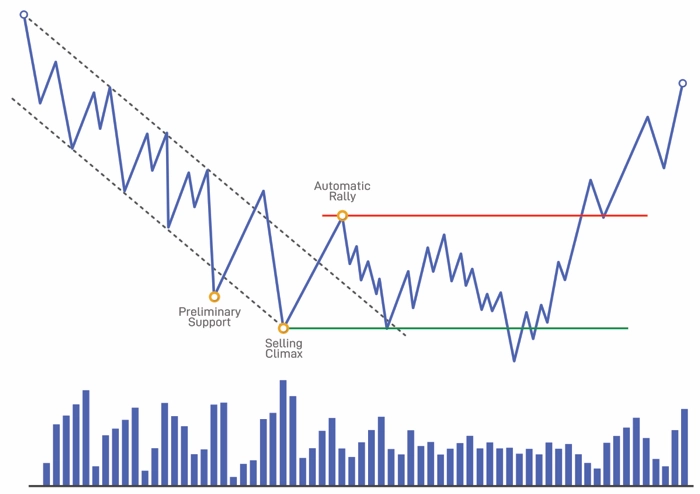
It is an event that forms part of Phase A of stopping the previous trend and takes place before the Selling Climax, the Automatic Rally, and the Secondary Test.
What is the Preliminary Support?
The Preliminary Support (PS) is the first attempt to stop a bearish movement that will always fail. It constitutes an early warning indicating that the bearish trend may be coming to an end.
It is the first event of the Wyckoff Method that initiates Phase A of stopping the previous trend. Together with the Selling Climax (SC), the Automatic Rally (AR), and the Secondary Test (ST), it produces the change of character that transforms the price from a bearish trend environment to a lateralization environment.
Important context: As we know, an accumulation process requires time and the price will rarely produce a hypodermic accumulation leaving a visual V-turn. This accumulation process begins with this first event, with the Preliminary Support.
Before this event occurs, the price will be falling in a healthy bearish trend. At some point, it will reach a level attractive enough for large operators that will make them begin to buy more aggressively.
How It Appears on the Chart
This event is often misinterpreted. A bearish bar with increased volume and range expansion is not necessarily what must be observed.
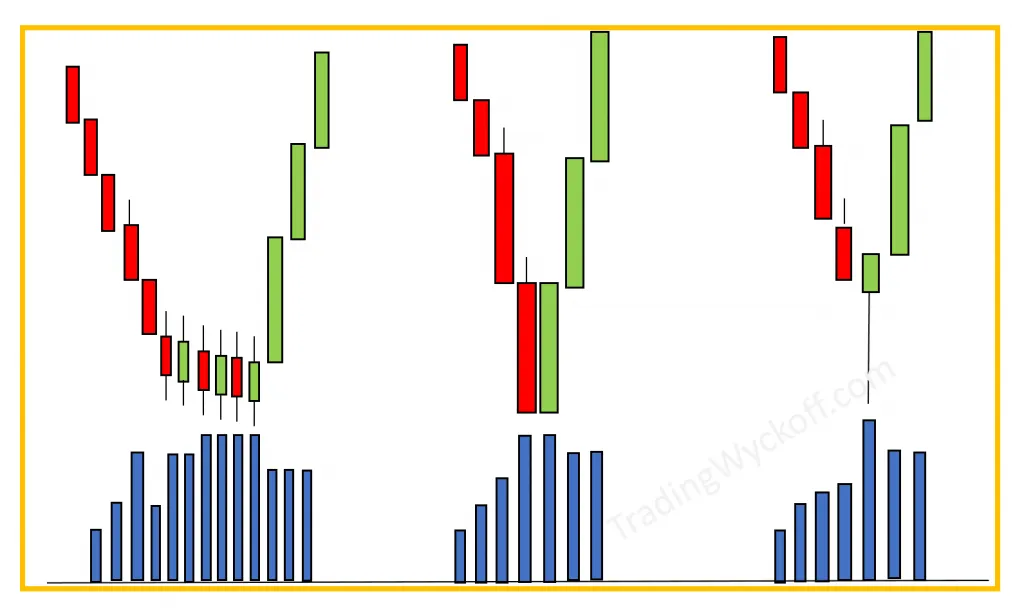
Three Ways the PS Can Appear
Bearish bar with high volume
The classic representation: a large bearish bar with a volume spike and close at lows after a prolonged downward movement.
Set of bars with constant volume
Several bars with relatively narrow range but high and constant volume throughout all of them.
Bar with large lower wick
A single bar with high volume and prominent lower wick, showing price rejection.
All these representations denote the same thing: the first relevant entry of large operators who consider the price attractive enough to begin buying.
"The market does not like large trend bars with significant volume increase after a prolonged movement, as they generally denote contrary sentiment."
- Tom Williams, Master the Markets
This action probably reaches an oversold condition in relation to the bearish channel that the price action respects during the descending movement.
Video in Spanish with English subtitles available

The Psychology of the Event
For someone to buy, there must be someone who sells. At this point, the large operator is buying while the "weak hand" sells.
Why do uninformed operators sell?
Out of fear
They see the price falling and enter short positions so as not to miss the downward movement. They sell late, just when professionals are buying.
Due to accumulated losses
Operators with medium-long term positions held through most of the decline. In losses, seeing it fall again, they close positions for fear of increasing losses.
Due to activated stop losses
Operators who think they are "smart" anticipate the bullish turn and enter long, but their stops are activated when the decline continues.
Stock transfer: In all cases, the shares pass from weak hands (scared retail) to strong hands (patient institutions). This transfer is the essence of accumulation.
Potential Preliminary Support
A bearish trend does not stop all at once. It is possible to find numerous attempts to stop the decline before the successful one. It is the inertia of the trend.
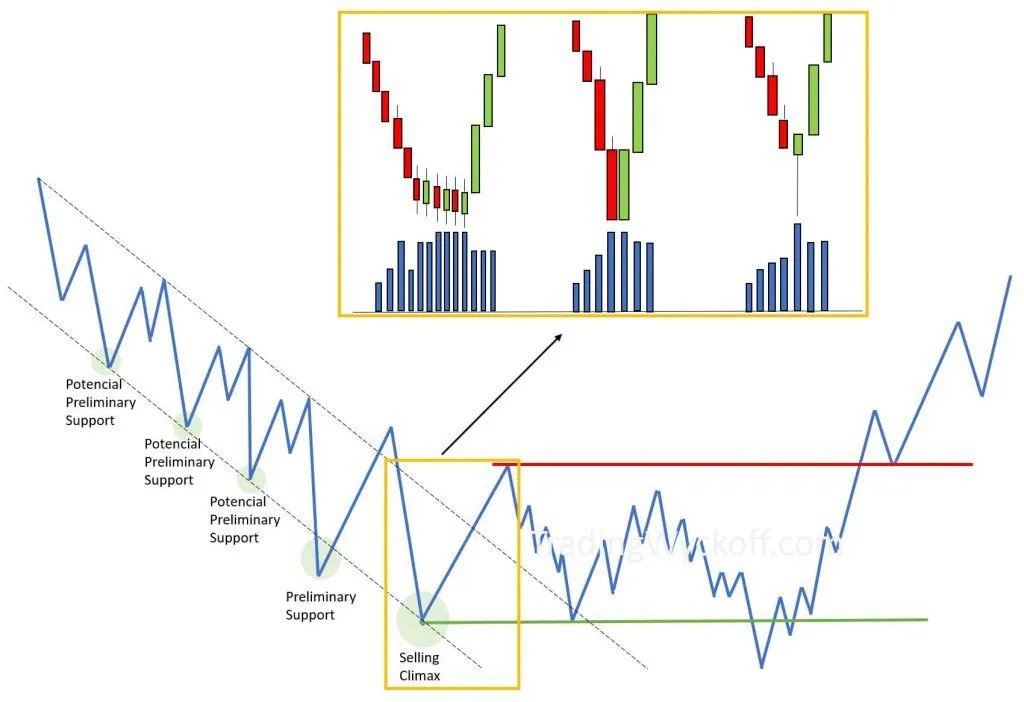
Multiple PS: All those stopping attempts are Preliminary Support. The more there are, the more likely the last extreme of the bearish trend will occur without a significant increase in volume.
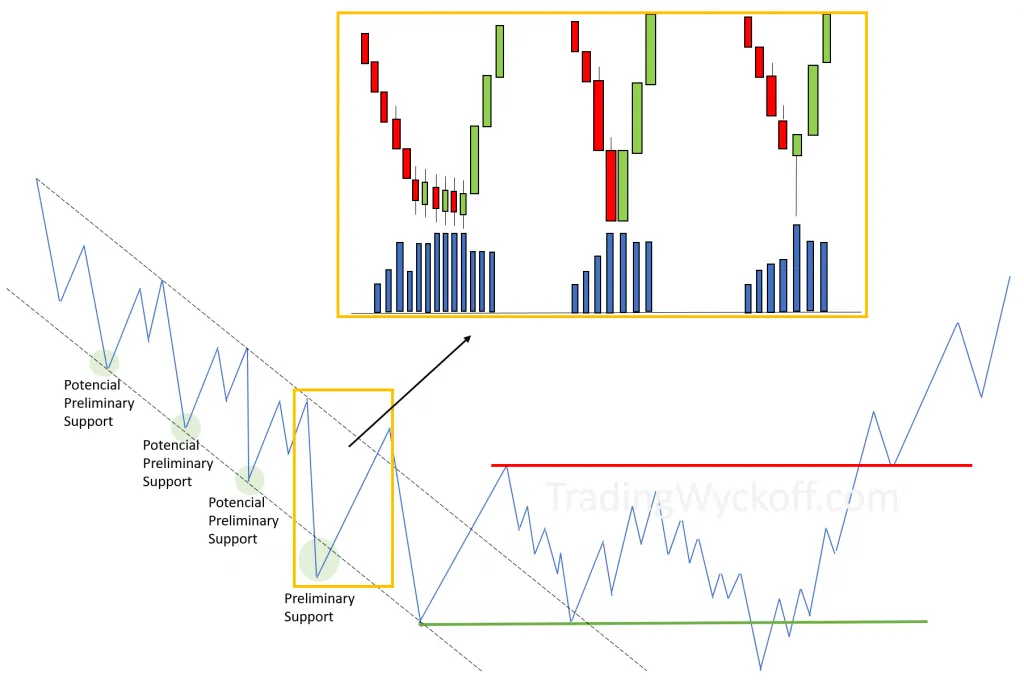
Seeing repeated Preliminary Supports suggests that the professional has been gradually eliminating supply from the market and when reaching the last low, few will be willing to sell; and this will cause that last extreme to occur without a volume spike. It will still be a Selling Climax, in this case without ultra-high volume: movement stop due to exhaustion.
Labeling: Functionally all are PS, but for Wyckoff, the PS will be the second-to-last stopping attempt (the last will be the Selling Climax). Previous ones are labeled as potential Preliminary Support.
This potential PS is confirmed as the genuine PS when the price develops the four Phase A events that establish the change of character.
This first professional participation does not imply that the price should turn immediately. As we have mentioned, in certain market conditions the price will develop a V-turn accumulating all the necessary stock during the decline. We repeat that although this type of hypodermic accumulation is not the most likely, one must be alert to its possible development.
Practical Uses
What is the purpose of identifying this first stopping event? It is the first stopping action of the bearish movement, allowing two clear conclusions:
- Stop thinking about the short side at least initially. A redistribution scheme could develop later to continue the decline, but that is evaluated afterward.
- Excellent point to take profits (close sell positions) if you are positioned on the short side.
Warning: It is not recommended to initiate long positions at the Preliminary Support. The risk assumed would be excessive since there is no confirmation yet that the accumulation will develop correctly. Better entry points come after the Secondary Test or Sign of Strength.

Wyckoff Methodology in Depth
This article is an excerpt from the book. If you want to master all Wyckoff methodology events and understand how to identify professional accumulations, the book provides all the necessary knowledge.
View book